Capability 04
Simulation and Measurement Campaigns
Simulation without measurement is an opinion. Measurement without a model is a table of numbers. The useful work is making the two disagree productively.
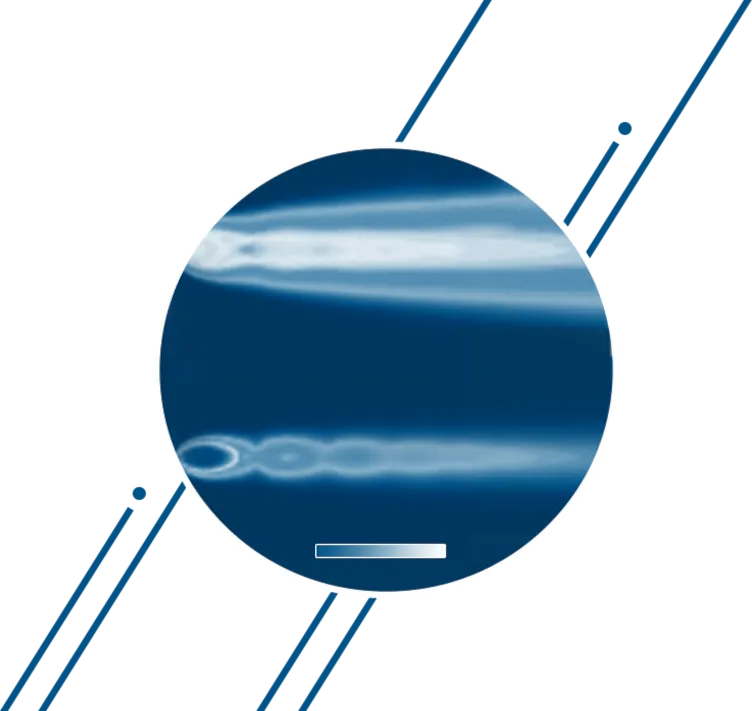
- 01 Near field Where the acceleration happens. Gradients here are steep, and mesh or particle-count choices show up directly in the answer.
- 02 Expansion Divergence of the plume, which sets how much of the momentum is actually useful.
- 03 Discharge structure Standing structure in the column. Whether it is physical or numerical is exactly the question a campaign answers.
- 04 Scale reference Every computed field is reported against a physical scale, so it can be compared with what a probe sees.
Modelling
Plasma devices span regimes that no single model covers well. Fluid and magnetohydrodynamic descriptions are efficient where the gas is collisional; particle methods are needed once it is not; electromagnetic solvers answer a different question again, about fields and coupling rather than flow.
Most of the judgement lies in knowing which description is defensible where, and in being explicit about what a given model cannot be asked. A result quoted outside the regime its model is valid in is worse than no result.
Measurement
On the bench side, the work is diagnostics: electrical probes into an environment that is actively hostile to them, optical methods where physical access would perturb the thing being measured, and thrust measurement, which is difficult to do honestly at the levels electric propulsion produces.
Every campaign is specified with its uncertainty budget written down first. A number without an error bar is not a measurement.
What we take on
- Model selection and setup, with the validity domain stated up front
- Convergence and sensitivity studies, reported rather than assumed
- Diagnostic specification and probe design
- Campaign planning: what is varied, what is held, how many repeats
- Reduction, uncertainty analysis and comparison against the model
- Reporting written so that a third party can reproduce the run
How an engagement runs
Either half can be delivered on its own, but they are stronger together: a model calibrated on one campaign predicts where the next one should look, and a campaign designed around a model tests the part of it that is actually load-bearing.
Where the hardware does not exist yet, this work usually precedes thruster design. Where it does, it runs on a bench built for it.