Capability 01
MPD and Arcjet Thrusters
Two ways of putting energy into a propellant, and two very different sets of constraints. We work on both, and on the awkward ground between them.
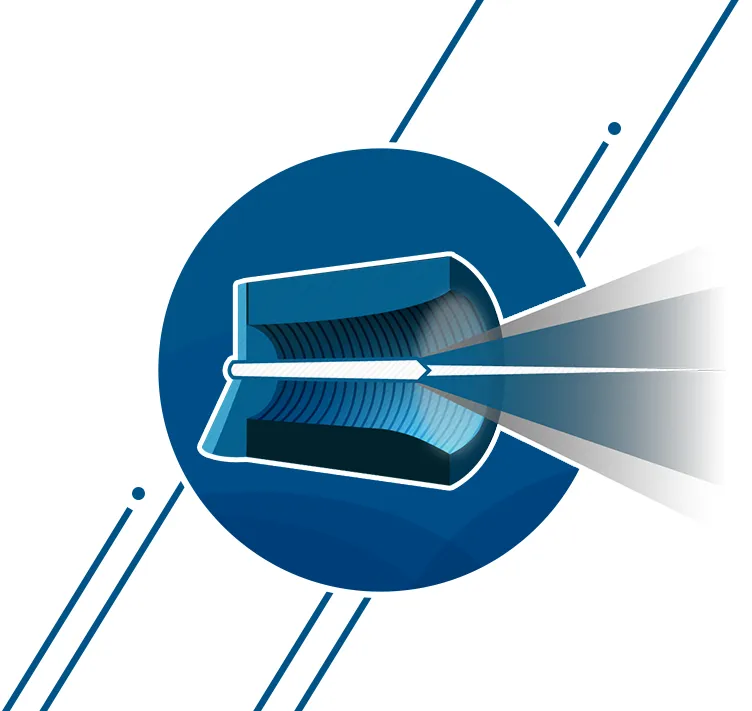
- 01 Anode Outer electrode. Its flare sets how far the discharge expands before the flow leaves the device.
- 02 Central cathode Emits the current that closes the circuit through the gas. Its erosion rate bounds operating life.
- 03 Discharge region Current crossing the ionised gas induces its own magnetic field; the Lorentz force drives the plasma downstream.
- 04 Accelerated exhaust The plume carries the momentum out. Its divergence is a first-order term in delivered thrust.
The physics we work with
An arcjet is electrothermal. A sustained arc heats the propellant well past what a combustion chamber could reach, and a conventional nozzle turns that enthalpy into directed velocity. The limit is material: everything downstream of the arc has to survive the temperature that makes the device worth having.
A magnetoplasmadynamic thruster is electromagnetic. Current runs radially through an ionised gas between a central cathode and a surrounding anode. That current induces its own azimuthal magnetic field, and the resulting Lorentz force accelerates the plasma along the axis — no thermal bottleneck, but a strong appetite for current.
Both share the problems that make electric propulsion hard: getting the discharge to strike reliably, holding it stable once struck, and keeping electrode erosion slow enough that the device outlives its mission.
What we take on
- Electrode geometry and material selection, with erosion as a design variable
- Propellant feed and injection, including the transition to stable operation
- Ignition and re-ignition behaviour across the operating envelope
- Thermal paths, so that the heat produced has somewhere defined to go
- Integration with the drive electronics, treated as one system rather than two
Where it applies
Electric propulsion earns its place wherever total impulse matters more than thrust: orbit raising, station keeping over a long service life, drag compensation in very low orbit, and end-of-life disposal. It is a poor fit anywhere a manoeuvre has to be completed quickly.
Arcjets sit at the higher-thrust, lower-efficiency end of that trade. MPD devices sit at the other, and only become interesting when the available electrical power is large enough to feed them.
How an engagement runs
Work usually starts from a required impulse and an available power budget, not from a thruster type. From there the sequence is conventional: sizing, electrode and feed design, a fired prototype, then a characterisation campaign on a bench built for the purpose — see test benches and measurement campaigns.