Capability 03
Plasma Test Benches
A thruster is only as credible as the bench it was fired on. We build facilities where a discharge can be produced, observed and produced again the same way.
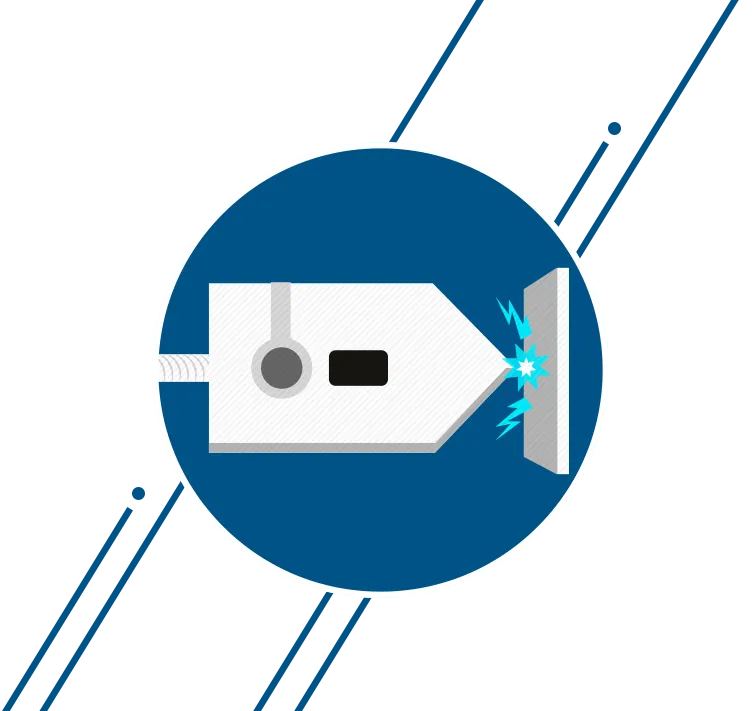
- 01 Electrode holder Sets and holds the gap. Any play here appears directly in the measurements as scatter.
- 02 Actuated adjustment Gap varied under control, so a sweep is a parameter of the run rather than a manual reset between runs.
- 03 Discharge The arc itself, struck between the electrodes and observed through the instrumentation ports.
- 04 Instrumented frame Rigid, electrically defined structure. Grounding and return paths are part of the mechanical design.
What a bench has to do
Firing a plasma device outside its intended environment tells you very little. Ambient air changes the breakdown behaviour, loads the plume and hides the effects worth measuring. A useful bench reproduces enough of the operating environment that results transfer.
That means a vacuum chamber able to hold pressure against the propellant being fed into it, a feed system that delivers a known flow rather than an approximate one, electrical feedthroughs that pass high voltage without becoming the experiment, and optical and electrical access placed before the chamber is built rather than drilled in afterwards.
And it has to be repeatable. A facility that produces a different answer on Tuesday is an expensive random number generator.
What we take on
- Specification and integration of vacuum facilities and pumping
- Propellant feed, flow control and the plumbing that has to stay leak-tight
- Electrode fixtures, adjustable geometry and motion under vacuum
- High-voltage feedthroughs, grounding topology and return paths
- Diagnostic access: electrical probes, optical ports, thrust measurement
- Acquisition and interlocks, including what happens when a run goes wrong
Built for someone else's device
Benches are frequently built around hardware we did not design. That is a normal request and often the more interesting one: it forces the facility to be general enough to survive the next device as well as the current one.
How an engagement runs
From the measurement you need, backwards. What has to be resolved determines the diagnostics, which determine the chamber and its access, which determine the structure. Doing it in the other order produces a facility that cannot see the effect it was built for.